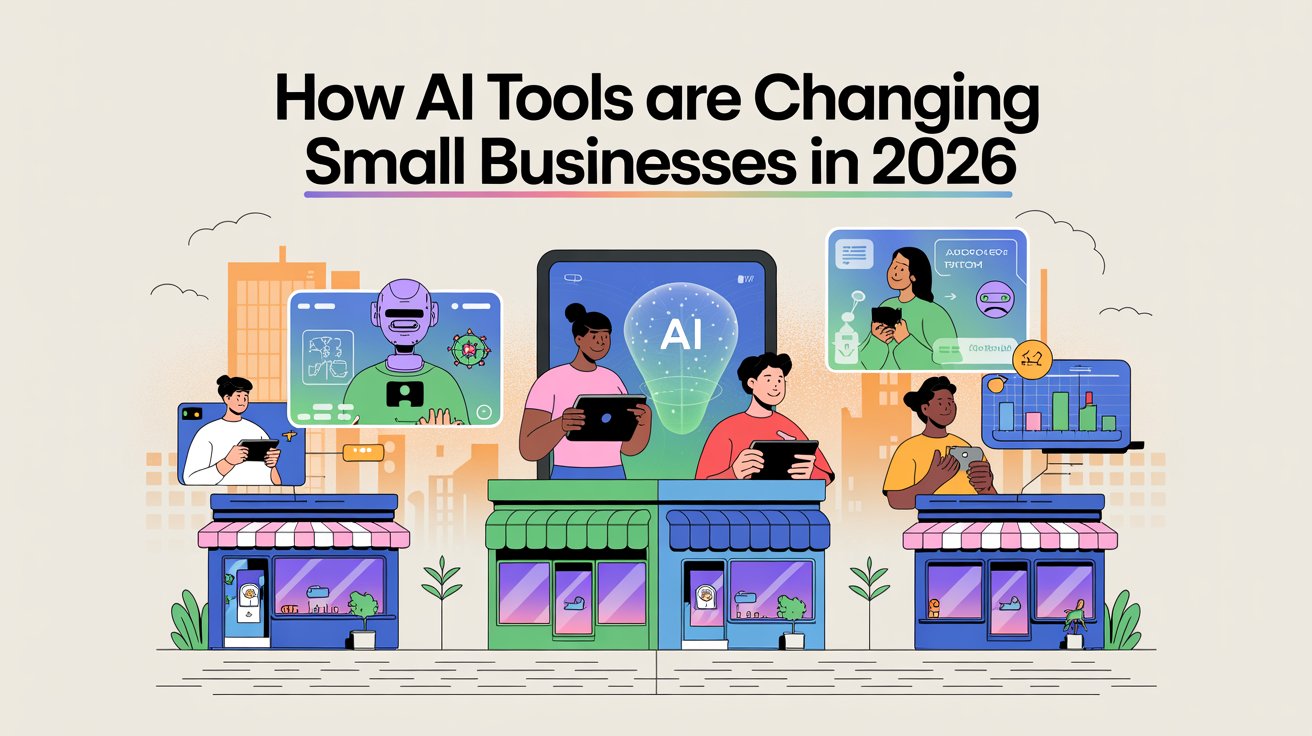
How AI Tools Are Changing Small Businesses in 2026
A few years ago, the technology that large companies utilized to develop sophisticated analytics, automated marketing, 24/7 customer support and data-driven decision making was beyond the means of small business owners. It was more expensive than it was worth, and that was all it took. It was exacerbated by the learning curve.
AI tools for small businesses are truly available in 2026. Affordable. And in lots of instances, entirely free to use. Previously, an owner might spend hours filling out product descriptions, answering the same customer questions over and over, and manually posting content on social media, but now they’re running leaner, faster, and smarter without hiring an extra person.
This isn’t hype. This is what is really happening in kitchens, garages, home offices and small storefronts all over the country.
So that’s a true picture of what that change means and how it’s impacting more in 2026 than ever before.
The Problem Small Businesses Have Always Faced
Being a small business owner is no easy task. You’re the owner, the marketer, the customer service rep, the accountant, the social media manager and the delivery person all in the same day. You have to wear all of the hats and there are never enough hours to wear them all properly.
Large firms do not have this issue. They hire specialists. They have teams for each of their functions. They have tool and software budgets that could bankrupt a small operation in a month.
One of the most frustrating facts of being an entrepreneur for decades is that big businesses can do so much, and small businesses cannot afford to do so much.
Also Read About: Best AI Tool for Packaging Design in 2026
1. Content Creation and Marketing Done in Minutes, Not Days
With AI writing tools, the AI can help you create blog posts, social media captions, email newsletters, product descriptions, ad copy, and website content without hiring a professional copywriter. In the last two years there has been a tremendous improvement in quality. Out of these tools comes something other than filler content – it’s real, usable content which can be lightly edited and published.
Consider, say, a small packaging company. They have everything from custom shipping supplies to the mobile charger boxes for electronics companies. Writing product descriptions for fifty different SKUs used to take a week 2 years ago. In 2026, it takes an AI tool an afternoon to produce a first draft, and the owner just has some time to edit an existing draft rather than a new draft.
Time savings add up rapidly. The more content you have, the more visibility you will have. The more visible, the more customers. Of course, and more customers, that’s what it’s all about!
2. Customer Service That Works Around the Clock
Every day, small business is losing customers because they were not able to get answers to their questions. You get a visitor at 11pm to your site who wants to know about your shipping terms or return policy and doesn’t hear back from you, so they purchase elsewhere.
Even the smallest of businesses are using AI chat tools on their website and social media pages in 2026. These tools include answering frequently asked questions, tracking orders, dealing with basic complaints and gathering contact information for follow-up without any human interaction.
The result? Customers receive a quick response to their inquiries. Businesses cease to lose sales due to lack of communication. Owners end up not answering the same five questions three hours a day with emails.
This has had a game-changing effect for small e-commerce brands in particular. In recent years, customers’ expectations have skyrocketed. People are expecting immediate answers. Even for a single man, AI makes that a reality.
3. Financial Management Without the Financial Manager
Invoicing, expense tracking, cash flow management, tax preparation – these are time-consuming, easy-to-miss, and stressful for people that set up a business to sell a product or service, not to be an accountant.
This is now largely automated using AI tools for Financial. They link to bank accounts and payment solutions, classify payments, make profit and loss statements, mark out-of-the-ordinary expenditure, and even remind people to pay their bills.
Some tools even forecast cash flow shortages weeks ahead of time, offering time for business owners to respond before a cash flow issue becomes an emergency. This used to involve employing a part-time bookkeeper for early warning. Now that happens automatically, without you having to do anything, and for a monthly subscription fee of less than an hour of professional accounting time.
4. Social Media Management That Doesn’t Eat Your Day
For small businesses in 2026, social media is a must. It’s where customers find brands, learn about products and make purchasing choices. However, persistent posting, responding to comments and monitoring what happens is a real time-suck.
These are tools that analyze your audience’s actions and give you suggestions on when to post. They provide content proposal suggestions that are relevant to their industry’s current trends. They write captions, create hash tags, and post to various social media sites automatically. Some go so far as to track brand mentions and identify mentions that require a human response.
A small business owner, who once spent two hours of his day dealing with social media, can do it in twenty minutes and make more effective results – the AI is doing the things that the data tells it to do, which a busy human simply wouldn’t have the bandwidth to calculate.
5. Smarter Hiring and Team Management
AI is now transforming even small businesses with a handful of employees to maximize efficiency in that aspect.
AI can generate job descriptions that appeal to a job seeker, filter CVs to find the most relevant applicants, and even come up with questions for your interview. From a team management perspective, AI scheduling software automatically manages shift planning, time-off requests, and workload distribution.
These tools do not save time, but they also ease the mental burden of juggling people and schedules for a small business owner who runs every aspect of the business.
Why 2026 Is a Turning Point Not Just Another Tech Trend
It’s easy to hear, “AI is transforming business,” and put it in the back of your mind along with many other trends and technologies that said they were going to revolutionize the world, but now have faded into the background.
The companies that jumped the gun on AI tools two years or more ago often when they were less sophisticated and usable are now structurally ahead. They’ve created workflows around these tools. Their staff members are familiar with their usage. These are the things they are doing better than their competitors who waited to make their decisions, produce content and serve their customers.
This is a strong sense of urgency for small businesses. Not panic but productive urgency. It’s still not too late in 2026 to use these tools and develop genuine competency in them before the competition. However, it will not continue to operate in perpetuity.
What to Expect Next
AI tools are going to keep getting better. This is not a big claim it’s simply the trajectory this technology has been on for years.
Speech-to-speech AI that answers the phone. AI tools to handle marketing campaigns from start to finish. Predictive inventory management, which informs you what to stock and when before there is a spike in demand. Individualized customer experiences that make every customer feel like your number one customer.
If small businesses take the leap to embrace AI tools now, they will be ready to embrace these advances naturally in their workflow. Lots of the ones who wait will be chasing a moving target.
The Bottom Line
AI tools are not taking the place of small business owners. They’re not invading the jobs, not stealing the creativity, not taking the human judgment that is what makes a business a company worth doing business with.
It’s their time that they’re giving back to small business owners. Saving hours that would otherwise be spent on repetitive, low-quality work and spending them on work that is important to growing a business.
The landscape of small and large businesses is leveling in 2026. What was once exclusive to the world of big companies with massive budgets and large teams is now accessible to anyone with a laptop and a desire to learn.
Not every one of the fastest growing businesses is currently the largest. They are the people who are smart enough to make use of what they have. If you haven’t begun yet, then there really is no better time than now.

Ehtisham Ahmad, the mind behind techspicies.com, is passionate about technology, innovations and SEO-driven content that empowers readers to stay ahead in the digital world.
Founder & CEO
Ehtisham Ahmad, the mind behind techspicies.com, is passionate about technology, innovations and SEO-driven content that empowers readers to stay ahead in the digital world.