How Technology Is Transforming Medical Billing and Revenue Cycle Management
Technology has changed almost every part of modern healthcare, from electronic health records to telehealth and digital patient communication. Medical billing is also becoming increasingly technology-driven. Healthcare practices now use digital tools to verify insurance information, manage claims, monitor payments, and identify issues that can delay reimbursement.
For medical practices, adopting the right technology can make billing workflows more organized while reducing repetitive administrative work. It can also help billing teams spend more time on complex tasks that require human attention.
The Growing Role of Technology in Medical Billing
Traditional medical billing often involves repetitive processes, manual data entry, paperwork, and communication between multiple departments. These processes can create delays and increase the possibility of errors.
Modern medical billing technology helps bring many of these activities into a centralized digital workflow. Billing teams can access patient information, claim details, payment records, and denial information through connected systems.
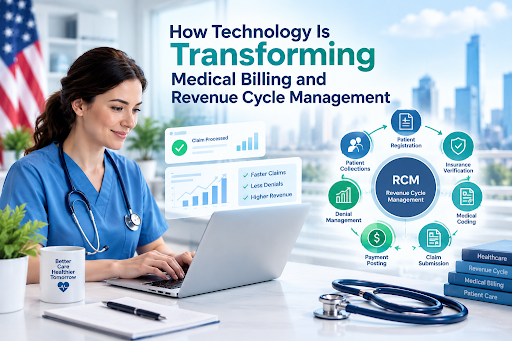
Technology can support several stages of the revenue cycle, including:
- Patient registration and data collection
- Insurance verification
- Medical coding workflows
- Electronic claim submission
- Claim status tracking
- Payment posting
- Denial management
- Accounts receivable follow-up
When these processes are connected, healthcare organizations can improve visibility across the billing cycle.
How Automation Can Reduce Repetitive Billing Tasks
One of the biggest advantages of technology is automation. Billing teams often spend significant time performing repetitive administrative tasks.
Automated systems can help with activities such as insurance eligibility checks, claim status updates, payment posting, and reminders. Instead of manually checking every item, staff can focus their attention on exceptions and more complicated cases.
Automation does not eliminate the need for trained billing professionals. Rather, it can give them better tools to manage their workload and identify problems earlier.
Better Data Can Support More Accurate Billing
Accurate data is essential for an efficient billing process. Incorrect patient information, outdated insurance details, or missing documentation can contribute to claim delays and rework.
Technology can help organize information and reduce unnecessary duplication. Integrated systems can make it easier for authorized staff to access relevant information when preparing and reviewing claims.
Healthcare practices should still maintain appropriate verification and review procedures. Technology can support accuracy, but human oversight remains important.
Technology and Claim Denial Management
Claim denials can create additional administrative work and delay reimbursement. A technology-supported workflow can make it easier to identify patterns in denied claims.
For example, a practice may discover that certain claims are repeatedly affected by missing information, coding issues, eligibility problems, or documentation gaps.
By analyzing denial data, billing teams can identify recurring problems and improve their processes. Instead of treating every denial as an isolated issue, practices can look for patterns and address the underlying cause.
Revenue Cycle Management Becomes More Data-Driven
Revenue cycle management involves much more than submitting claims. It covers the financial processes that connect patient registration, insurance, billing, payments, and accounts receivable.
Technology allows practices to monitor important information throughout this cycle.
Useful metrics may include:
- Claim acceptance and rejection rates
- Days in accounts receivable
- Outstanding balances
- Denial trends
- Payment turnaround
- Collection performance
Having access to this information can help healthcare administrators identify bottlenecks and make informed operational decisions.
Cloud-Based Tools Improve Accessibility
Cloud-based healthcare solutions have also changed how teams access billing information. Depending on the system and security configuration, authorized users may be able to work with billing information from different locations.
This can be particularly useful for organizations with distributed administrative teams or outsourced billing operations.
However, healthcare organizations should carefully evaluate data security, access controls, compliance requirements, vendor policies, and integration capabilities before selecting a technology provider.
Choosing the Right Medical Billing Technology
Not every practice needs the same technology. A small practice may have different requirements from a large healthcare organization with multiple locations and specialties.
Before adopting a solution, organizations should consider:
Integration
The technology should work effectively with existing systems where appropriate. Poor integration can create additional manual work instead of reducing it.
Usability
A complicated system can slow down staff productivity. An intuitive interface can make training and daily use easier.
Reporting
Useful reporting tools can help administrators understand billing performance and identify recurring issues.
Security
Healthcare organizations handle sensitive information, so security and appropriate access controls should be important considerations.
Scalability
The solution should be able to support the organization’s needs as the practice grows.
Technology Works Best With the Right People
Technology can improve medical billing workflows, but it is not a replacement for knowledgeable professionals.
Billing teams still need to understand payer requirements, coding practices, documentation, claim processes, and denial resolution. Technology provides tools and data, while experienced professionals use that information to make decisions and resolve complex issues.
For some healthcare organizations, working with specialized medical billing or revenue cycle management professionals can also provide access to established workflows and billing expertise without requiring the practice to manage every administrative function internally.
Conclusion
Technology is becoming an important part of modern medical billing and revenue cycle management. Automation, digital workflows, reporting tools, and integrated systems can help healthcare organizations organize billing processes and identify issues more efficiently.
However, technology alone is not enough. The strongest billing workflows combine appropriate technology with accurate data, well-defined processes, and knowledgeable professionals.
As healthcare continues to become more digital, practices that regularly evaluate their billing workflows and adopt suitable technology can build more organized and adaptable revenue cycle operations.
FAQs
What is medical billing technology?
Medical billing technology refers to digital tools and systems used to support healthcare billing activities such as insurance verification, claim submission, payment tracking, denial management, and reporting.
Can automation reduce medical billing errors?
Automation can reduce certain types of manual data-entry and workflow errors, but it does not guarantee error-free billing. Human review and appropriate processes remain important.
How does technology help with claim denials?
Technology can help billing teams track denied claims, identify recurring patterns, and organize information needed for follow-up and resolution.
What is the connection between medical billing and revenue cycle management?
Medical billing is one component of revenue cycle management. RCM covers a broader range of financial processes, from patient registration and insurance verification through claims, payments, and accounts receivable.

Ehtisham Ahmad, the mind behind techspicies.com, is passionate about technology, innovations and SEO-driven content that empowers readers to stay ahead in the digital world.
Founder & CEO
Ehtisham Ahmad, the mind behind techspicies.com, is passionate about technology, innovations and SEO-driven content that empowers readers to stay ahead in the digital world.