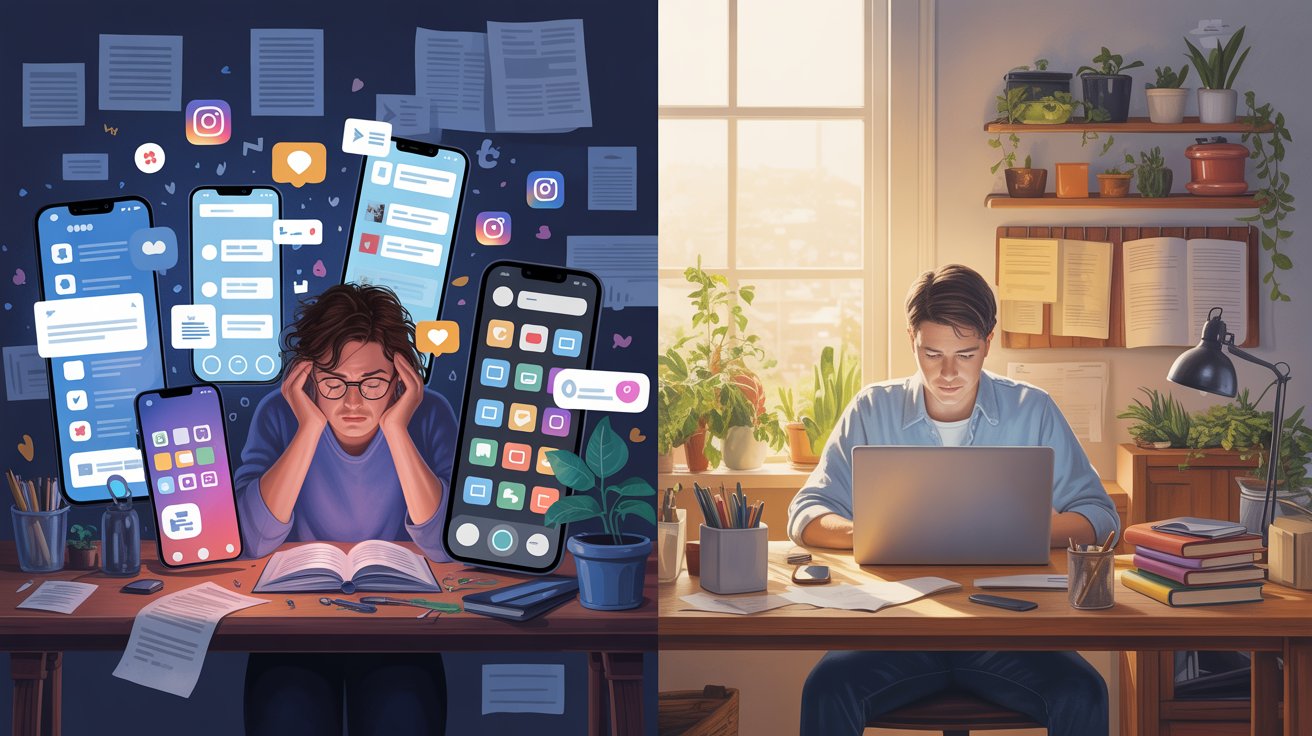
Social Media and Productivity: Finding Focus in a Distracted World
Millions of people use social media applications daily with the aim of checking something in a flash. Yet minutes turn into hours. The lunch-time short scroll turns into a plunge into posts, videos, and messages. This isn’t accidental. Space is created to retain your attention. They render being connected easily and difficult to focus. To be productive today does not only mean working hard but being able to deal with the distractions of a world where nobody is willing to bring themselves up to date.
The Attention Economy and Its Dark Side
Social media is attention-based. The longer the time users spend scrolling, the more likely they are to platforms. The algorithms research your behaviour, what you watch, pause on, or skip out, and recommend more of what you will keep you watching. This plan is time-rewarding. The result? Focus fades. That is where such tools as Instanavigation come by. They allow making the transition between platforms or even accounts easy, but the same convenience can cause spending more time in the Internet. Hours may also be lost when self-control is lost by what may save a few seconds.
It is not not using technology but how to use it without letting it consume you.
How Social Media Disrupts Deep Work
Deep work refers to the period in which your brain is wholly engaged in one activity, i.e., writing, designing, coding, or learning. It’s when creativity thrives. But every announcement shatters that state. The moment one looks at a phone, the concentration is thrown off by a few minutes. The frequent interchange of activities and applications leaves the brain fragmented as a result of mental residue. Towards the end of the day, individuals get to be busy and yet unproductive. Workload is not what is making people exhausted; it is the incessant mental overloading. To get actual work done, it is important to learn how to shut off the digital noise.
The Psychology of the Scroll
Endless content is a calming activity, although it is a well-crafted stimulation. Every like, mention or comment causes a dopamine release, a tiny reward of chemicals that encourage the users to come back. The brain becomes addicted to such fast hits the more the brain demands them. In the long run, the process of scrolling becomes automatic, a subconscious response to boredom or stress. It takes cognizance to break this loop. It is not about getting rid of all apps, but rather about giving time between thinking and acting. You are back to your control when you take a break before opening a program.
The Effect of Social Media on Work and Study
Professionals and students are time-focused but not goal-oriented; they strive to be higher-order thinkers. Social media breaks that richness. Looking at the updates at work or during a study break may not appear to be harmful; however, it distorts concentration. Every time one returns to the main task, it requires more time to reorient the brain. The fewer people who can remember, the more digital work they do, the less efficiently they do it. It is not the platform that is energy-consuming, but the constant switching of the mind. Creating app-free zones in the workplace or in a learning environment would also act as a way of safeguarding concentration and energy.
Technology is not a Trap: It is a Tool
The same technology that is distracting, ironically, can be used to develop discipline.
Applications now have the options to control the use, screen time, focus mode, and scheduled breaks. Even such analytics tools as Instagram Story Viewer may lead to mindfulness when used correctly. They provide creators with information to improve their work instead of spending their time on vanity metrics. Tech is neutral; it increases habits. It can be introduced to purpose and improve creativity, focus. In their futile application, it wastes two.
The Fine Line Between Connection and Distraction
Social media is highly social; it ensures that individuals remain in touch with friends, news, and ideas. However, it may also become addictive. In cases where users keep on making updates incessantly, they confuse connection with productivity. It is as though progress is being made, only it is a holding back. Being mindful in interaction, posting intentionally, responding when it is important, and knowing when to go offline bring true productivity. Boundaries make social media a distraction instead of a useful means of communication.
A Discipline in Building Digital
Attention is a muscle; the more one exercises it, the better it becomes. Start with small habits. Disabling unneeded notifications. Do not keep your phone on sight during work. Establish specific hours when one should socialize and follow them. The other trick is the replacement of the scroll habit. Whenever you want to take a peep at your phone, go out, stretch your legs, or write a note. These instances of consciousness recondition the brain to go not after constant stimulation but to be calm. As you control attention, so productivity will increase automatically.
Future of Focus in a Connected Age
There is a change of culture in digital marketing. The price of being always connected is being realized by more people, and the need to find a balance. Apps of the future can be capable of detecting mental fatigue and can automatically recommend that one take a break. The companies also start appreciating deep work time as compared to multitasking. The discussion is not as much about the amount of time we spend on the web, but rather about the way we feel after doing so. The following decade will not focus on productivity but rather on doing things meaningfully.
Conclusion
One of the strongest tools that has ever been developed is social media. It links, enlightens, and motivates. However, when there is no balance, it distracts, drains, and creates divisions of attention as well. It is not to stop but to make meaningful use of it. You recapture control by establishing boundaries, figuring out what you are doing, and safeguarding your focus.