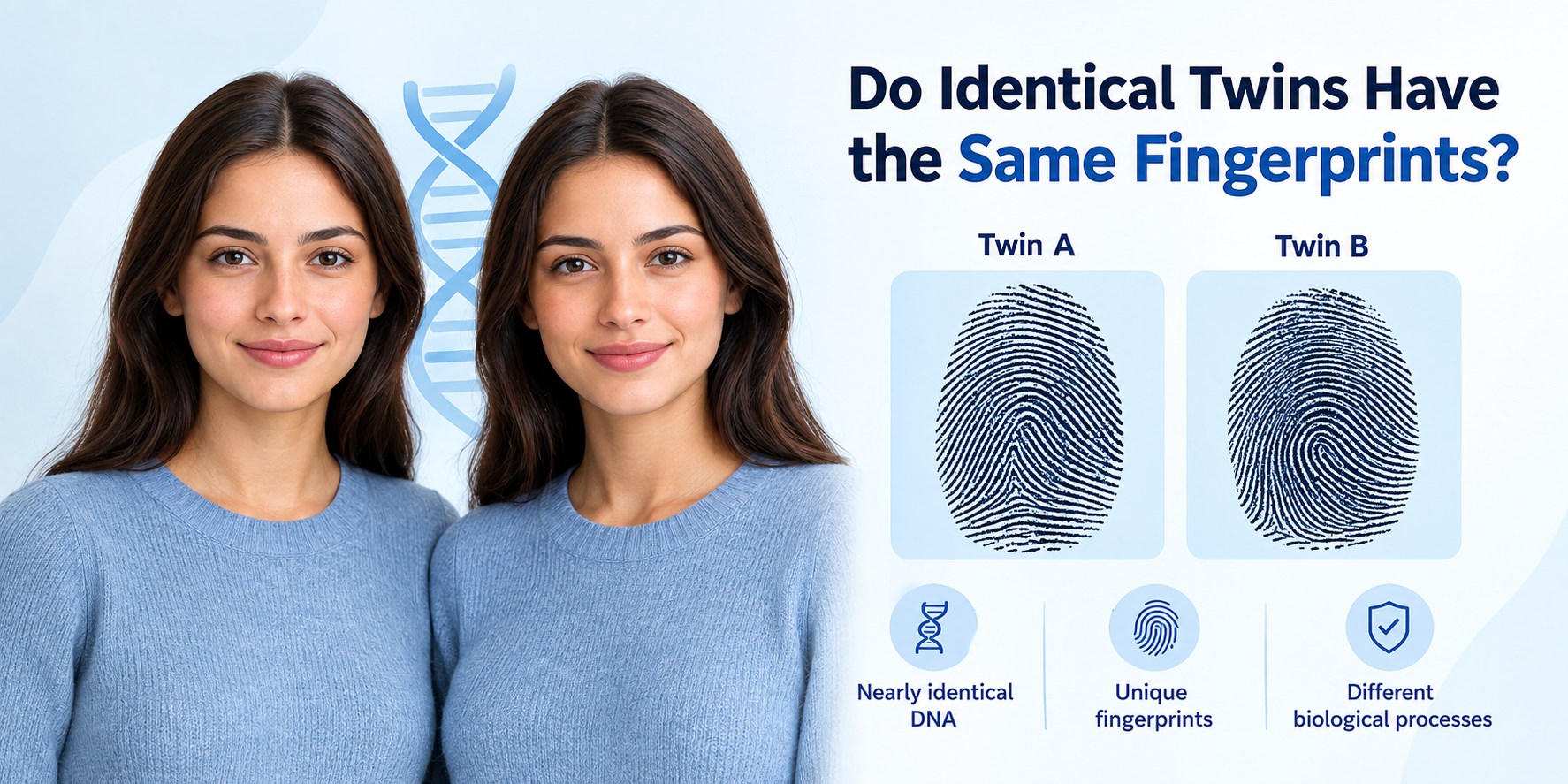
Do Identical Twins Have the Same Fingerprints?
Identical twins are often remarkably similar in appearance, which can raise questions about how closely their biological characteristics match. Since identical twins develop from the same fertilized egg, they share almost all of their genetic material. However, this does not mean that every physical characteristic is exactly the same.
One common question is: do identical twins have the same fingerprints? Although identical twins have nearly identical DNA, their fingerprints are not identical. Each twin develops a unique pattern of ridges and details on their fingertips.
Understanding the relationship between fingerprints, genetics, and twin development helps explain why fingerprints can distinguish even people who share extremely similar DNA.
Do Identical Twins Have the Same Fingerprints?
No, identical twins do not have the same fingerprints.
Identical twins, also called monozygotic twins, originate when one fertilized egg divides into two embryos. Because they come from the same original egg and sperm, they have nearly the same genetic makeup. However, fingerprint development is influenced by both genetics and conditions inside the womb.
During fetal development, small differences in factors such as the position of each fetus, blood circulation, pressure on the developing fingers, and the surrounding environment can influence fingerprint formation. These differences affect the precise details of the ridges on each person’s fingertips.
As a result, identical twins may have similar overall fingerprint patterns, but the fine details are different.
For example, both twins may have fingerprints that generally contain loops or whorls. However, the exact ridge endings, splits, spaces, and other characteristics will vary.
Also Read About: Celebrities with Noonan Syndrome: Confirmed Cases & Awareness
Why Do Identical Twins Have Different Fingerprints?
Fingerprint formation begins before birth. The basic patterns are influenced partly by genetics, but the final fingerprint is shaped by a combination of genetic and developmental factors.
Several factors can contribute to differences between the fingerprints of identical twins:
Genetic Influences
Genes play an important role in the development of fingerprints. They influence the general structure and characteristics of the skin and fingers. This is one reason family members can sometimes have similar fingerprint patterns.
However, genes do not provide a complete blueprint for every individual ridge and detail. Identical twins share nearly all of their DNA, but fingerprint development still involves additional developmental influences.
Conditions in the Womb
The environment surrounding a developing fetus can affect how fingerprints form. Identical twins do not occupy precisely the same position in the uterus, and their developing hands can experience different pressures and movements.
Differences in the amount of space available, contact with the amniotic environment, and blood supply may contribute to variations in fingerprint ridge formation.
Random Developmental Differences
Small biological variations occur naturally during fetal development. Even when two embryos have nearly identical DNA, their development does not happen in exactly the same way.
These tiny differences can influence the final details of fingerprints, making each person’s fingerprints unique.
Do Identical Twins Have the Same DNA and Fingerprints?
The answer is they have nearly the same DNA but different fingerprints.
When asking do identical twins have the same DNA and fingerprints, it is important to separate genetics from physical characteristics. Identical twins develop from the same fertilized egg and therefore share almost all of their nuclear DNA.
However, identical does not mean that their genomes remain perfectly indistinguishable throughout their lives. Small genetic differences can arise as cells divide and develop. These differences are known as somatic mutations.
Fingerprint patterns, meanwhile, are not determined by DNA alone. Their development is affected by both inherited factors and conditions during fetal development.
Therefore, two identical twins can have highly similar genetic profiles while still having fingerprints that are distinguishable from one another.
Do Identical Twins Have the Same DNA and Fingerprints?
The question do identical twins have the same DNA and fingerprints can be answered by looking at each characteristic separately.
Identical twins generally have extremely similar nuclear DNA because they originate from the same fertilized egg. This is why standard DNA testing can have difficulty distinguishing between identical twins.
Fingerprints are different. Even though identical twins can share similar fingerprint patterns, the detailed ridge characteristics are not the same.
This distinction is important in forensic science. A fingerprint found at a scene can potentially distinguish between identical twins because fingerprints contain individual characteristics that are not determined solely by a person’s DNA sequence.
How Similar Are Identical Twins’ Fingerprints?
Identical twins can have fingerprints that look remarkably similar at first glance. They may share broad fingerprint patterns, such as:
- Loops
- Whorls
- Arches
However, the detailed ridge characteristics can differ significantly.
Fingerprint identification does not depend only on the general appearance of a fingerprint. Examiners can analyze smaller characteristics, including ridge endings, bifurcations, and the relationships between individual ridges.
Consequently, two fingerprints can belong to identical twins while still containing enough distinguishing information to identify them as coming from different individuals.
Do Identical Twins Have the Same DNA?
Identical twins share nearly all of their inherited nuclear DNA, but their genetic profiles are not necessarily perfectly identical in every cell.
As embryos develop, cells divide repeatedly. Mutations can occur during these divisions, meaning that one twin may acquire a small genetic change that the other twin does not have. Additional genetic and epigenetic differences can also develop over time.
These differences are generally very small and do not change the fact that identical twins are genetically much more similar to each other than ordinary siblings.
This is also why advanced genetic analysis may sometimes distinguish between identical twins when conventional DNA profiling cannot.
Can Fingerprints Be Used to Tell Identical Twins Apart?
Yes. Fingerprints can be used to distinguish identical twins because each twin has a unique fingerprint pattern.
Forensic identification relies on the detailed characteristics of fingerprint ridges rather than simply determining whether two people have loops, whorls, or arches.
Even when identical twins have very similar fingerprints, the exact arrangement of their ridge details can differ. These differences can provide useful identifying information.
This is one reason fingerprints remain an important form of biometric identification.
Why Fingerprints Are Different From DNA
DNA and fingerprints provide different types of biological information.
DNA contains genetic information inherited from biological parents. Identical twins receive almost the same genetic material because they originate from the same fertilized egg.
Fingerprints are physical patterns that develop during fetal growth. Genetics influence their development, but environmental and developmental factors also affect the final pattern.
This means fingerprints can be unique even among people with extremely similar DNA.
Are Identical Twins Completely Identical?
Despite the name “identical twins,” twins are not identical in every biological characteristic.
They usually share very similar:
- DNA
- Blood type
- Physical characteristics
- Genetic traits
However, they can differ in:
- Fingerprints
- Some physical features
- Certain acquired characteristics
- Small genetic changes
- Epigenetic patterns
Their environments, experiences, and development can also contribute to differences that become more noticeable over time.
Conclusion
So, do identical twins have the same fingerprints? No. Identical twins do not have identical fingerprints, even though they generally share nearly the same DNA.
Fingerprint development is influenced by genetics as well as conditions and developmental processes that occur before birth. This creates unique ridge patterns and fine details for each twin.
When asking do identical twins have the same fingerprints and DNA, the answer is that they have nearly identical nuclear DNA but different fingerprints. Similarly, do identical twins have the same DNA and fingerprints can be answered by recognizing that DNA and fingerprints develop through different biological processes.
The difference between genetic similarity and fingerprint uniqueness is one reason fingerprints can help distinguish identical twins, while conventional DNA testing may not always be able to do so.

Ehtisham Ahmad, the mind behind techspicies.com, is passionate about technology, innovations and SEO-driven content that empowers readers to stay ahead in the digital world.
Founder & CEO
Ehtisham Ahmad, the mind behind techspicies.com, is passionate about technology, innovations and SEO-driven content that empowers readers to stay ahead in the digital world.