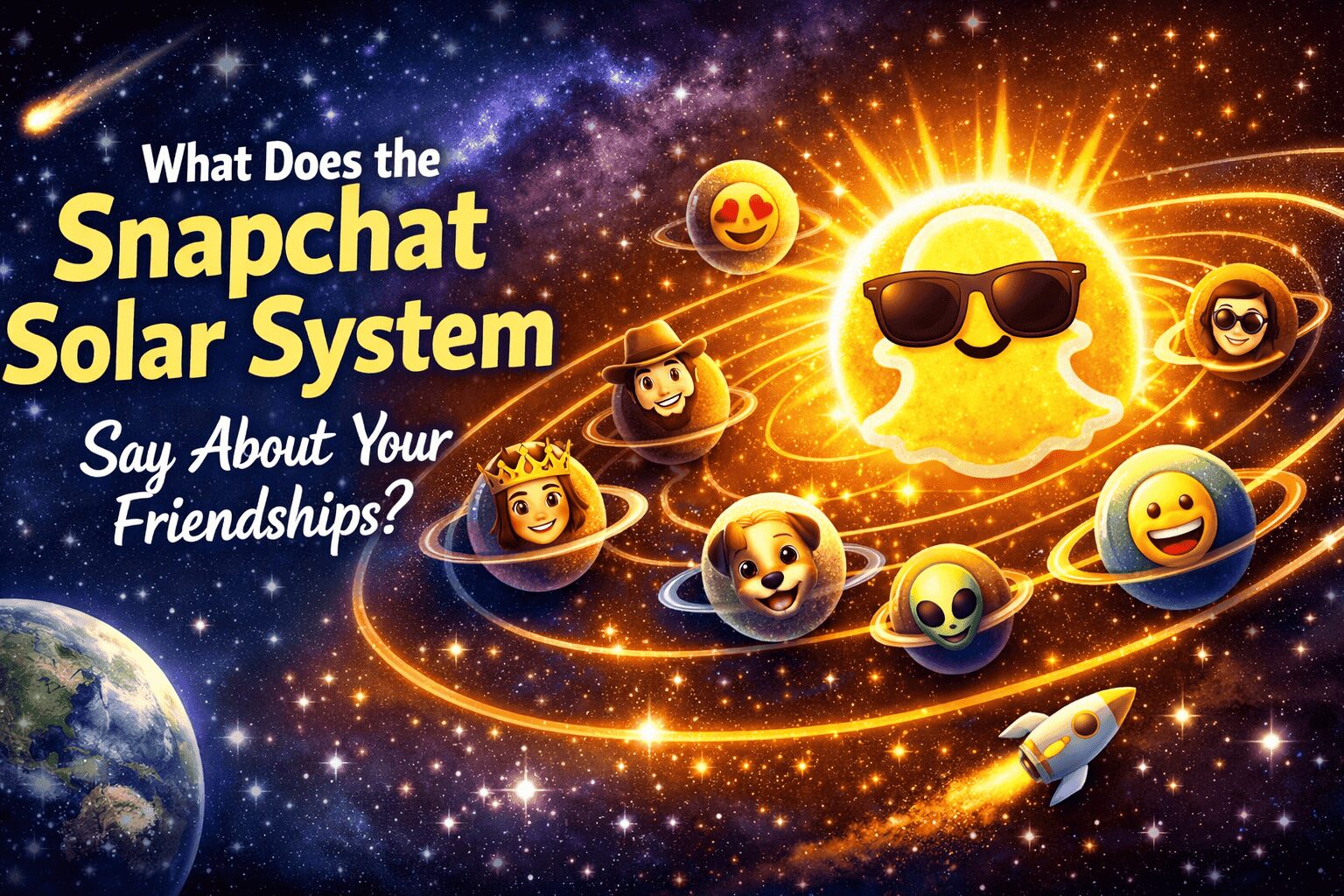
What Does the Snapchat Solar System Say About Your Friendships?
You are not alone in questioning what it all actually means if you have ever clicked on a buddy’s profile and observed planets circling around a little Sun. The Snapchat Solar System first seems almost game-like in its playfulness. The more you see planets disappearing, showing, or moving, however, the more personal it becomes.
Unexpectedly, you start inquiries you did not foresee:
Why did this person move closer?
Why would one’s movement be more distant?
Does this genuinely say anything regarding my pals?
Let’s pause and disassemble what the Snapchat Solar System actually reveals and what it does not.
What Is the Snapchat Solar System, Really?
The Snapchat Solar System is a visual feature available to Snapchat+ users. Instead of listing your best friends in plain text, Snapchat turns your friendships into a miniature universe.
You are the Sun in this setup; your closest pals appear as planets spinning around you. The nearer a planet is, the more interaction you have with that person on Snapchat.
On the surface, it seems fun, but beneath it is motivated by actual data: how frequently you stay in contact as well as your snaps and chats.
Why Did Snapchat Turn Friendships into Planets?
Creativity and feeling have always been leaning on Snapchat. Rather than displaying rankings or cold figures, the Solar System gives something people already cherish social closeness and personality.
Furthermore, it appeals to inquisitiveness. Finding a planet causes you to stop. It encourages interpretation. And certainly it keeps you involved.
It more so provides Snapchat users a silent means of considering their communication habits without going public.
How Does the Snapchat Solar System Actually Work?
The Solar System is not based on popularity or arbitrary. It almost completely emphasizes one-to-one encounters.
Among the things Snapchats examine are:
- How often you transmit photographs
- How much you speak
- how constant your messaging is
- how recently your interaction was
Public narratives, followers, and viewership are rather insignificant here. This mechanism is personal, secret, and always modifying behind the scenes.
Also Read: What Impact is AI Having on Astrology Apps?
What Is the Snapchat Planets Order and Why Does It Matter?
Understanding the snapchat planets order helps make sense of what you’re seeing. Each planet represents a position in your best friends ranking.
Here’s the usual snapchat planets order:
- Mercury – Your most interacted-with friend
- Venus – Second closest
- Earth – Third
- Mars – Fourth
- Jupiter – Fifth
- Saturn – Sixth
- Uranus – Seventh
- Neptune – Eighth
The closer the planet is to you, the stronger your Snapchat activity with that person. Simple in theory but emotionally, it can feel complicated.
What Does It Mean If Someone Is Your Mercury?
Seeing someone as Mercury may be unexpectedly strong.
Mercury often represents:
- You snap one another frequently.
- Conversations are easy and daily events.
- Keeping in touch mostly depends on Snapchat.
This is a best buddy for others. For some, it’s a lover, a crush, or that one person you speak with all day without much consideration.
Still, Mercury mirrors frequency, not necessarily emotional depth. Somebody can be very important to you without ever being Mercury.
What Do the Middle Planets Say About Stable Friendships?
Often the most at ease friendships are represented by Venus, Earth, and Mars.
These are the people you:
- Confidence
- Check in often.
- Feeling close does not depend on daily contact.
These relationships appear equilibrium. No pressure; just consistency. Many people actually identify more with these planets than Mercury because they more closely reflect actual intimacy.
What If Someone Is Farther Away, Like Neptune?
Seeing someone as Neptune might hurt a little particularly if they mean something to you. Neptune, however, does not imply that the relationship is bad or vanishing.
It typically means:
With them, Snapchat usage declines.
Your discussions take place somewhere else.
Life just turned hectic.
Strong friendships may be found offline or on other channels. Snapchat misses those times; that’s acceptable.
Why Do Planet Positions Keep Changing?
The frequency of the Snapchat Solar System’s movement makes it among the most perplexing elements.
That is so it refreshes by itself. Should you start taking someone more shots, they come closer. Should you slow, they wander away.
Usually reflecting timing not intent, these alterations rankings might be impacted by a hectic week, a new schedule, or a break from social media.
Does the Snapchat Solar System Reflect Real Emotional Closeness?
Not completely and that’s important to remember.
The Solar System measures:
- Interaction
- Frequency
- Consistency
It does not measure:
- Loyalty
- History
- Trust
- Real-life connection
A friend you’ve known for years may appear farther away than someone you recently started snapping daily. That doesn’t make one relationship more meaningful than the other.
Should You Be Concerned If Someone Moves Away?
It’s natural to notice and even overthink planet changes. But most shifts are harmless.
Someone moving outward usually means:
- They’re busy
- They’re using Snapchat less
- They’re talking to you elsewhere
It’s rarely personal. Algorithms don’t understand context, emotions, or unspoken bonds.
Who Can See Your Snapchat Solar System?
This is one area where Snapchat gets it right.
Your Solar System is:
- Completely private
- Visible only to you
- Not shareable by others
Friends can’t see which planet they are in your universe, and they can’t see your rankings. That privacy keeps the feature reflective rather than competitive.
Can Two People Have Different Planet Rankings?
Yes and this surprises a lot of people.
You might see someone as Mercury, while you’re only Earth or Mars in their Solar System. That simply means one person interacts more than the other.
It doesn’t mean the friendship is one-sided. It just means habits differ.
Can the Snapchat Solar System Affect How People Feel?
It can especially if taken too seriously.
Some users start comparing friendships, chasing rankings, or feeling anxious about planet changes. That’s when the feature stops being fun.
Used casually, it’s interesting. Used obsessively, it can distort how you view relationships.
How Can You Use This Feature in a Healthy Way?
A good rule of thumb:
- Treat it as insight, not judgment
- Don’t force conversations to change rankings
- Focus on quality, not frequency
Friendships don’t need algorithms to be real.
Frequently Asked Questions About Snapchat Solar System
What is the snapchat planets order?
The snapchat planets order ranks your top friends from Mercury (closest) to Neptune (farthest) based on interaction.
Can I change my planet rankings manually?
No. Rankings update automatically based on your activity.
Does sending more snaps move someone closer?
Yes, consistent snapping and chatting usually increase closeness.
Is the Snapchat Solar System available to everyone?
No, it’s a Snapchat+ feature.
Can someone see their planet in my Solar System?
No. Only you can see your Solar System.
Final Thoughts: What the Snapchat Solar System Really Says
The Snapchat Solar System ultimately mirrors your actions rather than defining your relationships. It displays who you chat to most on Snapchat, not who is most important in your life.
Viewing it as an enjoyable, pictorial snapshot of your daily online activities can be fascinating and possibly even enlightening. Just avoid allowing planets to take the place of real talks, shared memories, or sincere connection.
Because the best pals do not need an orbit to demonstrate their existence.

Ehtisham Ahmad, the mind behind techspicies.com, is passionate about technology, innovations and SEO-driven content that empowers readers to stay ahead in the digital world.
Founder & CEO
Ehtisham Ahmad, the mind behind techspicies.com, is passionate about technology, innovations and SEO-driven content that empowers readers to stay ahead in the digital world.