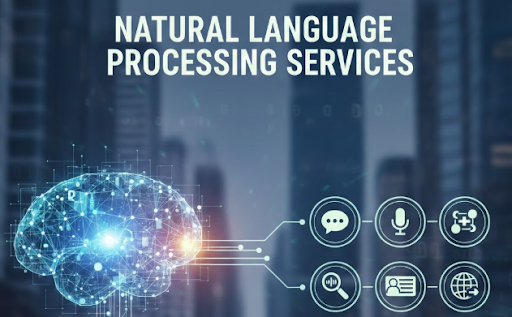
What Are Natural Language Processing Services and Why They Matter
The accelerated pace of digitalization has greatly augmented the amount of language-based data produced by companies. Businesses are now dealing with an unprecedented amount of unstructured information in the form of customer support tickets and social media discussions, contracts, internal documentation, and chat transcripts.
Estimates in the business community indicate that almost 80-90% of enterprise data remains unstructured and that a significant part of unstructured data consists of text and speech. Traditional analytics tools are not designed to interpret human language at scale. As a result, organizations are increasingly investing in Natural Language Processing Services to convert language into structured, actionable intelligence.
NLP is no longer a curiosity, but it is a core to all businesses that want to achieve efficiency in their operations, automation, and interact more with their customers.
What Are Natural Language Processing Services?
Natural Language Processing Services are AI-powered solutions that enable machines to understand, interpret, analyze, and generate human language.
These services integrate:
- Machine learning software.
- Deep learning models
- Transformer architectures
- Large Language Models (LLMs)
- Computational linguistics
The goal is to convert unstructured text and speech data to structured outputs that are useful in automation, analytics, and decision-making.
In contrast to older rule-based systems, modern NLP models are contextual, intent-aware, sentiment-aware, and intent-focused, in addition to understanding their environment.
Core Capabilities of Natural Language Processing Services
Enterprise-grade NLP implementations typically include the following components:
1. Text Classification
Sorts documents, emails, or support tickets automatically into topics. This enhances automation of the workflow, and manual labor is minimized.
2. Sentiment Analysis
Interprets customer feedback to evaluate the level of emotional tone, positive, neutral, or negative to brand monitoring and service optimization.
3. Named Entity Recognition (NER)
Extract and process structured data items like names, dates, location, product reference, and financial values in a text.
4. Conversational AI & Chatbots
Powers smart virtual assistants that have the ability to interpret the needs of the user instead of having a predetermined response.
The use of conversational AI has also resulted in organizations automating 60-80% of repetitive customer contact, thereby saving them a lot of money in terms of operational expenses.
5. Document Summarization
Summarizes long reports, contracts, or research papers into brief summaries, which helps in accelerating decision-making by the executives.
6. Machine Translation
Favors multilingual presence and localization of market expansion to international markets.
Why Natural Language Processing Services Matter
Unlocking Value from Unstructured Data
Unstructured data is one of the least exploited enterprise assets. The insights that are contained in text data cannot be accessed without NLP capabilities.
By leveraging Natural Language Processing Services, organizations can:
- Determine common customer sore points.
- Track product attitude trends.
- Dump compliance-related information.
- Identify organizational inefficiencies.
This change takes language as passive content to strategic intelligence.
Enhancing Customer Experience
The consumers of today seek quick, precise, and customized communication. NLP-driven systems enable:
- 24/7 automated support
- Context-aware engagement
- Faster issue resolution
- Improved retention metrics
Companies applying NLP to the customer experience processes tend to report a quantifiable change in customer satisfaction and efficiency of response.
Driving Operational Efficiency
The processes of reviewing documents manually, routing of tickets, and extraction of data are time-consuming and subject to error. NLP automation saves and improves the accuracy of processing.
In the industries involving a lot of documents, AI-based language automation has the potential to cut the processing time by as much as 40-50% and enhance productivity without raising the number of employees.
Industry Applications of Natural Language Processing Services
Healthcare
Clinical and administrative texts associated with healthcare produce large amounts of text data. NLP plays a crucial role in:
- Clinical documentation analysis.
- Categorization of medical records.
- Symptom extraction by means of automation.
- Clinical decision support
When integrated within broader Healthcare IT Solutions and Services, NLP enables smarter electronic health record (EHR) management, automated coding, improved patient communication, and enhanced compliance monitoring. It helps medical professionals to provide more precise diagnoses and individual treatment plans and uphold regulatory quality.
Financial Services
- Contract intelligence
- Fraud detection via communication monitoring
- Regulatory compliance analysis
eCommerce & Retail
- Customer review analysis
- Voice search optimization
- AI-powered product recommendations
Legal & Insurance
- Claims processing automation
- Policy review
- Risk identification
The NLP is applied in different ways in each sector, yet the general goal is going to be the same: to derive structured knowledge by analyzing language data and make improved decisions.
Strategic Implementation Considerations
While the advantages are substantial, the successful deployment of Natural Language Processing Services requires careful planning.
Data Privacy & Compliance
Information in language datasets is usually sensitive. Organizations need to do:
- Secure data infrastructure
- Encryption standards
- Regulatory compliance systems.
Model Customization
Generic NLP models are basic functionality models. But, the performance of the enterprise edition needs:
- Domain-specific training
- Incremental model optimization.
- Contextual fine-tuning
Cooperation with seasoned AI vendors like Sparx IT Solutions can enable companies to design scalable, secure, and industry-native NLP systems.
The Future of Natural Language Processing Services
The development of NLP goes in line with the development of generative AI. New trends are:
- AI co-pilots in the enterprise systems.
- Voice-operated operational interfaces.
- Intelligent agents that are context-driven.
- Text, image, and speech AI.
In healthcare specifically, NLP-driven Healthcare IT Solutions and Services are evolving toward predictive analytics, automated clinical documentation assistance, and AI-supported telehealth interactions.
As language becomes the primary interface between humans and digital systems, organizations investing early in Natural Language Processing Services will be better positioned to scale automation and maintain competitive agility.
Proactive technology associates such as Sparx IT Solutions are empowering companies to capitalize on the promise of advanced NLP features being incorporated into larger AI change initiatives.
Conclusion
Language is the focus of any interaction in the enterprise: communication with the customer, internal cooperation, documentation of compliance, and interaction with the market.
Natural Language Processing Services convert this language into structured intelligence, enabling automation, improving customer experiences, and supporting data-driven decisions.
When integrated with broader digital transformation initiatives such as Healthcare IT Solutions and Services, NLP becomes even more powerful—bridging operational efficiency with strategic innovation.
In the case of organizations operating in an economy that is slowly becoming AI-based, NLP is not merely an improvement in technology but a strategic asset that the organization needs to ensure long-term operational sustainability and scalability.

Ehtisham Ahmad, the mind behind techspicies.com, is passionate about technology, innovations and SEO-driven content that empowers readers to stay ahead in the digital world.
Founder & CEO
Ehtisham Ahmad, the mind behind techspicies.com, is passionate about technology, innovations and SEO-driven content that empowers readers to stay ahead in the digital world.