
Ukulele History: Origins and Cultural Roots Explained
Ukulele is not only a small, four-stringed instrument that is related to the tropical beach and the soft sound. It is the representation of cultural fusion, a testimony to the strength of Hawaiian people, and a worldwide trend that has been revived several times throughout the past century. To trace the history of the ukulele we need to go out of Waikiki and take a voyage that takes us across oceans, including Portuguese artisans, and Hawaiian monarchs.
What is the Original History of Ukuleles?
Although the ukulele is associated with Hawaii, it was its forebears who were born in Europe. A ship called the SS Ravenscrag reached Honolulu harbor in the late 19th century, namely in the year 1879. It was transporting more than 400 Madeiran immigrants, who were of Portuguese origin.
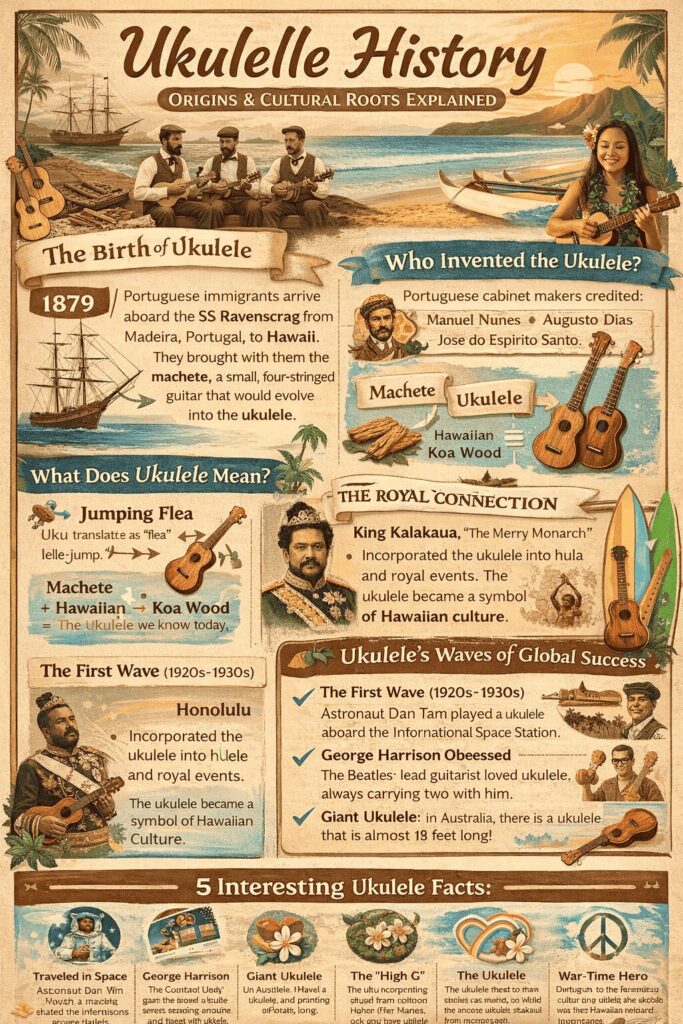
These immigrants brought their traditions, music and a four-stringed, guitar-like instrument, small in size, called machete de braga (or simply machete). The machete was high-pitched, lively and portable-qualities that would in the future become synonymous with the ukulele.
Who Invented the Ukulele?
Although nobody can be said to have invented the idea of a small guitar, ukulele etymology shows that three Portuguese cabinet makers who came on the SS Ravenscrag, are credited with inventing the ukulele as we know it today, namely Manuel Nunes, Augusto Dias, and Jose do Espirito Santo.
After the end of their contracts in the sugar cane fields, these three craftsmen relocated to Honolulu where they started to make musical instruments. They made the Portuguese machete design, but with local Hawaiian Koa wood, which made the instrument sound warmer and richer than the European spruce. The most prolific of the three is usually quoted as Manuel Nunes who later considered himself the Inventor of the Ukulele.
What was the original name of the Ukulele?
The machete was the ancestor of the ukulele in its motherland, Portugal. But it has also DNA with the rajao, which is a five-stringed instrument of the same area. Once the instrument arrived in Hawaii people were amazed by the fast movements of the fingers of the Portuguese musicians.
The uke name was picked up very soon, although before it became a household name around the world, it was rigidly known by its Portuguese origins or by its Hawaiian descriptive titles.
What Does the Ukulele Mean in Hawaiian?
There are two widely accepted definitions of the term ukulele and both of them provide an insight into the way the instrument was viewed by the Hawaiian people:
- Jumping Flea: The most widespread translation. Uku translates as flea and lele translates as to jump. There is a legend that as the Hawaiians observed the new type of fingerpicking played by the Portuguese musicians it appeared to them that the fleas were jumping over the fretboard.
- The Gift that Came Here: Queen Liliuokalani, the final ruling Hawaiian monarch, wanted a more poetic explanation. According to her, the name was based on the uku (gift or reward) and the lele (to come). The instrument to her was a present of a distant country which had been incorporated in the Hawaiian identity.
The Royal Connection: the reason the Ukulele became famous.
Without the Hawaiian Royal Family, the ukulele may have continued to be a niche instrument of immigrants. King David Kalakaua who was also referred to as Merry Monarch was a massive patron of the arts and wanted to revive the Hawaiian culture.
He incorporated the ukulele in the royal events, hula dance and parties. The King was personally playing the instrument and this made the instrument a symbol of the high society and national pride in Hawaii. This royal approval was the jump-starter that took ukulele out of Honolulu streets to the center of the Hawaiian culture.
The Ukulele Story of World Success (ukulele etymology)
The big break of the instrument on the world scene occurred in 1915 at the Panama-Pacific International Exposition, San Francisco. Ukulele musicians and hula dancers were performing at the Hawaiian Pavilion and this ignited a national frenzy in the United States.
The First Wave (1920s – 1930s)
Ukulele was the new instrument of the amateur musician in the Jazz Age. It was cheap, portable and simple to learn compared to the piano or the violin. It was a symbol of the Roaring Twenties, which was frequently linked to college campuses and vaudeville celebrities such as Cliff Edwards (Ukulele Ike).
Also read: Debby Clarke Belichick Net Worth
The Second Wave (1950s)
After the World War II, soldiers who had been back in the Pacific revived the interest in the culture of Tiki. It was during this period that plastic ukuleles (especially the Maccaferri so-called Islander) became available and the instrument was even more affordable to children and amateur players.
The Modern Revival
The ukulele experienced a tremendous revival in the late 1990s and early 2000s following a decline in popularity during the rock-and-roll era. This was fueled by:
- Israel IZ Kamakawiwoole: His blend of the songs, “Over the Rainbow/What a Wonderful World” turned out to be a global hit.
- The Internet: YouTube gave the stage to such virtuosos like Jake Shimabukuro and numerous tutorials on how to be a beginner.
What Does an Ukulele Represent?
The ukulele is more than mere physical strings and wood:
- Cultural Synthesis: It is the combination of European artisanship with Hawaiian soul.
- Joy and Simplicity: The ukulele is regarded as a more welcoming musical instrument in a busy world since anyone can play it.
- Hawaiian Sovereignty: To most Hawaiians, the ukulele represents their culture and their strength even to the face of adversity throughout history.
- Peace: It is mostly used as a symbol of Aloha; love, peace, and compassion due to its soft tone.
What are 5 Interesting Facts About the Ukulele?
- It Traveled in Space: In 2011, astronaut Dan Tani played a ukulele in the International Space Station.
- George Harrison Was Obsessed: The lead guitarist of the Beatles was a huge fan. He is known to have always carried two ukuleles with him in case somebody wanted to play with him.
- The Ukulele of the World: In Australia, there is a ukulele that is almost 13 feet long!
- The “High G” Mystery: The majority of stringed instruments become high in pitch and then low. The standard tuning of the ukulele (G4-C4-E4-A4) is re-entrant, i. e. the top string is higher than the other two strings, creating the distinctive sound of the ukulele, its strummy.
- A War-Time Hero: The ukulele was among the few musical instruments that could be purchased even by the average family during the Great Depression and WWII and it helped them forget about the hardships that befell them during that time.
The Ukulele Today: A Thriving Legacy
The ukulele is no longer understood as a toy or simplified guitar. It is considered as a justified concert instrument. Since the traditional soprano, the lower tenor and baritone models have been introduced and fit all the styles of music, a folk and pop to the classical and jazz.
You are a professional musician or picking up your first $50 mahogany uke, but you are a part of a 150-year-long tradition of more than a thousand miles. The history of the ukulele is a migration tale, royalty tale, and the human universal wish to create a happy noise.

Ehtisham Ahmad, the mind behind techspicies.com, is passionate about technology, innovations and SEO-driven content that empowers readers to stay ahead in the digital world.
Founder & CEO
Ehtisham Ahmad, the mind behind techspicies.com, is passionate about technology, innovations and SEO-driven content that empowers readers to stay ahead in the digital world.