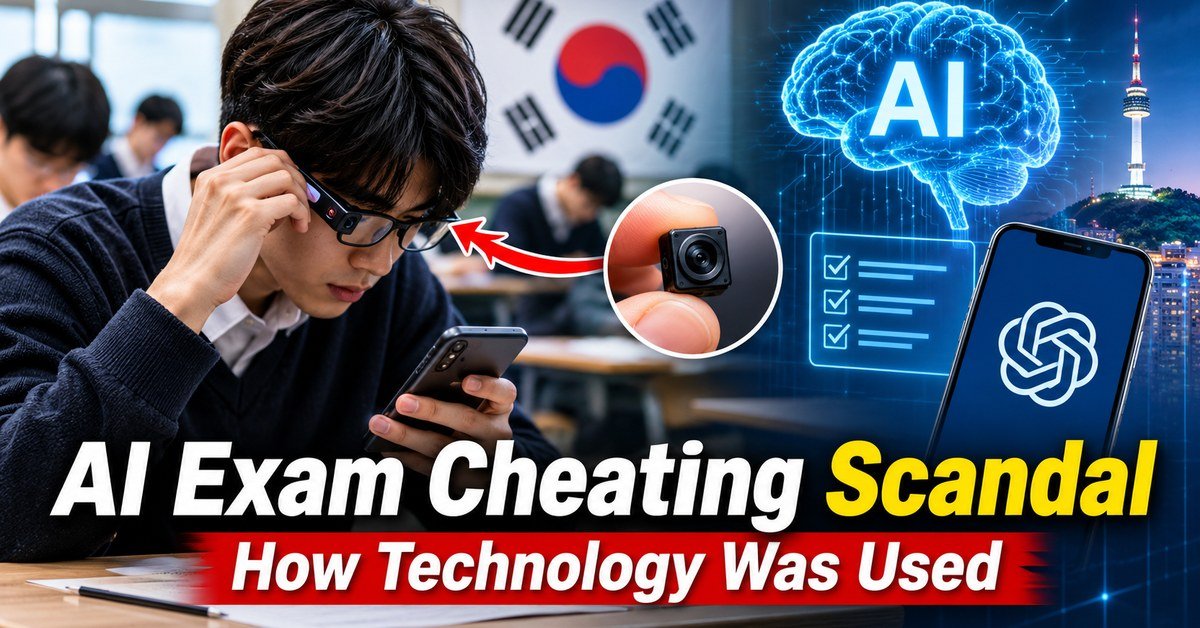
South Korea AI Exam Cheating Scandal: How Technology Was Used
Artificial intelligence is changing the way people learn, work, and access information. From solving complex problems to generating detailed answers within seconds, AI tools have become increasingly powerful. However, their growing capabilities are also creating new challenges for educational institutions.
A recent South Korea AI exam cheating scandal has brought this issue into the spotlight after a candidate who achieved the highest score in a national tax accountant examination admitted to using a hidden miniature camera, a smartphone, and generative AI to cheat.
The incident has attracted international attention because it demonstrates how modern technology can potentially bypass traditional examination security measures. It has also raised concerns about the use of AI-powered devices in schools, universities, and professional certification examinations.
Following the confession, South Korean authorities announced stricter examination security measures ahead of the country’s highly competitive university entrance examination.
But how did the candidate use AI to cheat? What technologies were involved? And what does this incident mean for the future of education?
Let’s explore the details.
What Happened in South Korea’s AI Exam Cheating Scandal?
The controversy began after a 34-year-old candidate named Han Won-seok secured the top position in South Korea’s national certified tax accountant examination.
His results attracted considerable attention because of his exceptionally high performance in both examination stages.
According to international media reports, Han scored 397.5 out of 400 in the first stage of the examination, answering 159 out of 160 questions correctly. He subsequently scored 663 out of 800 in the second stage, eventually becoming the overall top scorer.
Initially, his performance appeared to be an extraordinary academic achievement. However, other candidates and experienced professionals began questioning the results because of the unusually high scores.
The controversy intensified after Han admitted that he had used electronic devices and generative AI to obtain answers during both examination stages.
On November 15, 2026, he publicly acknowledged the cheating in a video published on his lawyer’s YouTube channel. He also submitted a written confession to the Seoul Metropolitan Police Agency.
His admission triggered a police investigation and raised serious questions about the effectiveness of South Korea’s examination security procedures.
The incident quickly became an international technology story, highlighting the potential misuse of artificial intelligence in high-stakes examinations.
How Was Artificial Intelligence Used to Cheat?
One of the most concerning aspects of this incident was the combination of relatively simple electronic equipment with modern AI technology.
According to Han’s confession, the process involved capturing examination questions and using an AI application to generate answers.
The reported method involved three main technological components.
1. Miniature Hidden Camera
The candidate reportedly used a small camera to photograph examination questions without attracting the attention of examination supervisors.
Miniature cameras are electronic devices designed to capture images while occupying very little physical space. Their compact size makes them difficult to identify through ordinary visual inspections.
In this case, the camera was reportedly used to capture examination questions and transfer the images for AI processing.
This raised concerns about whether conventional examination procedures can effectively identify increasingly compact electronic devices.
2. Smartphone and Generative AI
After capturing the examination questions, the candidate reportedly used a smartphone to send the images to an AI system.
Generative AI applications can analyze images, recognize written text, understand questions, and generate relevant responses.
For example, modern AI systems can:
- Read text from uploaded images.
- Understand multiple-choice questions.
- Analyze mathematical and logical problems.
- Explain complicated academic concepts.
- Generate answers based on available information.
The technology made it possible to obtain AI-generated assistance during the examination.
However, the exact AI application or model used by the candidate has not been publicly confirmed.
3. Accessing AI-Generated Answers
According to the confession, Han checked the AI-generated answers through his smartphone.
Authorities and investigators have not publicly established every technical detail of how the equipment was concealed and operated inside the examination room.
His lawyer also withheld certain details, citing concerns that revealing the complete method could encourage similar incidents.
Nevertheless, the confession demonstrated how a combination of image capture, smartphone connectivity, and generative AI could be used to undermine examination security.
Which Technologies Are Creating New Examination Security Risks?
The South Korean incident has drawn attention to several technologies that could potentially be misused during examinations.
Understanding these technologies is important because the problem extends beyond conventional smartphones.
Miniature Cameras
Small cameras can capture photographs and videos while remaining difficult to identify during routine inspections.
Their increasing availability has created additional challenges for examination authorities responsible for maintaining controlled testing environments.
Generative Artificial Intelligence
Generative AI is capable of analyzing information and producing responses based on user input.
Applications such as ChatGPT and Google Gemini demonstrate how AI can assist with text analysis, image interpretation, explanations, and problem-solving.
These capabilities are useful for legitimate educational purposes but can also be misused when external assistance is prohibited.
AI-Powered Smart Glasses
Smart glasses are wearable devices that combine conventional eyewear with electronic components.
Depending on the model, they may include cameras, microphones, wireless connectivity, and AI-powered features.
Some products can capture visual information and interact with connected AI applications.
These capabilities have made smart glasses another concern for examination authorities, particularly when devices can resemble ordinary eyewear.
Wireless Electronic Devices
Wireless communication allows electronic devices to exchange information without requiring traditional wired connections.
Small wireless accessories and connected devices can create additional examination security challenges.
However, it is important to distinguish between technologies confirmed in Han’s case and other devices discussed in the wider debate about AI-assisted cheating.
Why Are AI Smart Glasses Becoming a Concern in Examinations?
AI smart glasses have become an important part of the broader discussion surrounding technology-assisted cheating.
Unlike conventional glasses, smart eyewear can include cameras, microphones, wireless connections, and digital assistance features.
These capabilities allow users to interact with digital information while wearing what may appear to be ordinary eyewear.
For educational institutions, this creates a new challenge.
Traditional examination security procedures generally focus on identifying smartphones, notes, calculators, and other recognizable electronic devices.
However, wearable technology is changing the situation.
An examination supervisor may not immediately recognize whether a pair of glasses contains electronic components.
This is one reason South Korean authorities announced additional inspections of candidates’ eyewear ahead of the national university entrance examination.
The issue is not that every smart-glasses product is designed for cheating. Rather, it is that technology capable of providing unauthorized assistance can potentially be misused in controlled examination environments.
South Korea Introduces Stricter Examination Security Measures
Following the cheating confession, South Korean authorities announced additional security measures ahead of the 2026 College Scholastic Ability Test, commonly known as Suneung.
The examination is one of the country’s most important academic assessments because its results significantly influence university admissions.
The 2026 examination was scheduled for November 19, with more than 550,000 candidates expected to participate.
Authorities introduced several measures to prevent the unauthorized use of electronic devices.
Restrictions on Electronic Devices
Candidates are required to follow strict rules regarding electronic equipment inside examination rooms.
Smartphones, smartwatches, wireless earphones, and other unauthorized electronic devices are subject to examination restrictions.
Inspection of Glasses and Clothing
Examination supervisors were instructed to inspect candidates’ glasses and clothing for potentially concealed electronic equipment.
Authorities also announced measures involving stickers covering clothing buttons to help identify concealed miniature cameras.
Additional Examination Supervisors
South Korea planned to deploy approximately 8,400 additional examination inspectors across the country.
The additional personnel were intended to strengthen monitoring and improve examination security.
Metal Detectors and Additional Inspections
Authorities also announced the use of metal detectors and additional checks around examination venues.
These procedures were designed to identify unauthorized electronic devices before candidates entered examination rooms.
Stronger Penalties for Cheating
The government announced tougher consequences for candidates caught cheating using advanced electronic equipment.
According to Reuters’ November 17 reporting, authorities planned to extend the examination retake ban for university entrance examination cheating from one year to ten years.
The separate tax accountant examination also carries serious consequences, including potential qualification revocation and a five-year restriction on retaking the examination.
These measures demonstrate how seriously South Korea is treating the potential misuse of AI and electronic devices in academic assessments.
Is This the First AI Cheating Incident in South Korea?
No. The latest controversy is part of a wider pattern of technology-assisted cheating incidents reported in South Korea.
According to reporting by The Hankyoreh, authorities have encountered several incidents involving AI glasses and smartphones in professional qualification examinations during 2026.
These cases involved examinations for technical and professional occupations.
The growing availability of miniature electronic devices has made it increasingly difficult for traditional examination procedures to identify every possible security risk.
The issue also highlights a wider concern: examination authorities may need to update their security policies as quickly as technology continues to develop.
The latest tax accountant examination scandal has therefore become an important example of how AI-assisted cheating can threaten the credibility of professional qualifications.
Why Is AI-Assisted Exam Cheating Difficult to Detect?
Traditional examination systems were designed around a relatively straightforward principle: candidates should complete their assessments independently without unauthorized external assistance.
However, modern technology has changed the situation.
Several factors make AI-assisted cheating particularly challenging.
1. Increasingly Compact Devices
Electronic components are becoming smaller and easier to integrate into wearable products and other everyday devices.
This makes it more difficult to identify unauthorized technology through ordinary visual inspections.
2. Fast AI Processing
Modern generative AI systems can analyze images and generate responses quickly.
This reduces the time required to process questions and obtain information.
3. Multiple Connected Technologies
A single cheating attempt may involve several separate devices working together.
Identifying one device does not necessarily reveal the entire system being used.
4. Limitations of Traditional Monitoring
Examination supervisors often depend on visual inspections and candidate behavior.
These methods may not always identify sophisticated electronic equipment.
5. Rapid Changes in Technology
New AI applications, wearable devices, and electronic accessories continue to enter the market.
Examination authorities must regularly update their security procedures to address these developments.
How Can Educational Institutions Prevent AI-Based Exam Cheating?
The South Korean incident highlights the need for educational institutions to reconsider their examination security strategies.
Completely preventing access to every new technology may be difficult. However, institutions can introduce better assessment procedures and stronger security measures.
Here are several approaches that could help.
Stronger Electronic Device Screening
Examination authorities can improve screening procedures by introducing better equipment inspections, clear device submission policies, and trained security personnel.
Secure Examination Environments
Institutions can establish controlled examination areas where unauthorized electronic devices are restricted.
Additional supervision and consistent security procedures can help reduce opportunities for misconduct.
Practical and Oral Assessments
Written examinations are not the only way to evaluate academic knowledge.
Practical assignments, oral examinations, and supervised problem-solving activities can provide additional ways to assess whether candidates genuinely understand a subject.
More Focus on Critical Thinking
Instead of relying entirely on multiple-choice questions, educational institutions can introduce assessments that require students to explain their reasoning.
This makes it easier to evaluate subject understanding rather than simply checking whether a candidate selected the correct answer.
Clear Artificial Intelligence Policies
Educational institutions should establish clear guidelines explaining when AI tools are permitted and when their use constitutes academic misconduct.
Students should understand the difference between using AI to support learning and using it to misrepresent their independent performance.
AI in Education: A Learning Opportunity or a Threat?
Artificial intelligence is not inherently responsible for academic dishonesty.
The same technology involved in this controversy can provide significant educational benefits when used appropriately.
Students and teachers already use AI applications for several legitimate purposes.
Some common examples include:
- Explaining difficult academic concepts.
- Generating practice questions.
- Summarizing educational materials.
- Improving writing and research.
- Providing personalized learning assistance.
- Identifying knowledge gaps.
- Supporting programming and technical learning.
For example, students can use AI assistants to understand complicated subjects and practice solving questions before examinations.
You can also explore our guide on how AI is becoming part of everyday technology to understand how artificial intelligence is gradually becoming integrated into common digital activities.
Similarly, artificial intelligence and machine learning are becoming important areas of technological development, with applications across education, business, and software development.
The real concern begins when AI is used to misrepresent someone’s knowledge or performance in an assessment where independent work is required.
Educational institutions should therefore focus on responsible AI usage rather than treating every AI application as a threat.
What Does This Scandal Mean for the Future of Education?
The South Korean AI exam cheating scandal raises an important question: Can traditional examination systems remain reliable in an AI-powered world?
Artificial intelligence is changing how people access information, solve problems, and complete academic tasks.
As these technologies become more accessible, educational institutions may need to reconsider how they evaluate students.
Future examination systems could increasingly combine traditional assessments with practical evaluations, supervised tasks, oral examinations, and critical-thinking activities.
AI itself may also become part of the assessment process.
Instead of simply banning AI, institutions could evaluate whether students know how to use these tools responsibly, verify their outputs, and identify incorrect information.
This approach would help prepare students for workplaces where AI is becoming an increasingly important productivity tool.
Ultimately, the future of education will depend on finding a balance between technological innovation and academic integrity.
Frequently Asked Questions (FAQs)
1. What happened in South Korea’s AI exam cheating scandal?
A candidate who topped South Korea’s national tax accountant examination admitted to using a miniature camera, smartphone, and generative AI to cheat during both examination stages.
2. How did the candidate use AI to cheat?
According to his confession, he photographed examination questions using a miniature camera, sent the images to an AI system, and checked the generated answers through his smartphone.
3. Which AI application was used in the South Korean cheating scandal?
The exact AI application or model used by the candidate has not been publicly confirmed.
4. Why are smart glasses a concern during examinations?
Some smart glasses include cameras, microphones, wireless connectivity, and AI-powered features. These capabilities can potentially be misused to obtain unauthorized assistance during examinations.
5. What security measures has South Korea introduced?
Authorities announced stricter electronic device restrictions, inspections of glasses and clothing, additional examination supervisors, metal detectors, and tougher penalties for examination fraud.
6. Can artificial intelligence replace traditional examinations?
AI is unlikely to replace traditional examinations completely. However, educational institutions may increasingly combine written tests with practical assessments, oral examinations, and critical-thinking evaluations.
7. Is using AI for studying considered cheating?
No. Using AI for learning, research, and practice is generally acceptable when permitted by educational guidelines. It becomes academic misconduct when students use unauthorized assistance during assessments or misrepresent AI-generated work as their own.
Final Thoughts
The South Korea AI exam cheating scandal demonstrates how technological advancement can create challenges beyond the benefits it brings.
A combination of miniature cameras, smartphones, and generative AI reportedly allowed a candidate to bypass traditional examination security and achieve exceptionally high scores.
More importantly, the incident has exposed weaknesses in examination systems designed before modern AI-powered devices became widely accessible.
As artificial intelligence continues to evolve, educational institutions will need stronger security procedures and more effective assessment methods.
The solution may not be to ban AI entirely. Instead, it will require finding a balance between using artificial intelligence as a learning tool and protecting the credibility of academic qualifications.
One thing is clear: the future of education will require examination systems that are prepared for the realities of modern technology.

Ehtisham Ahmad, the mind behind techspicies.com, is passionate about technology, innovations and SEO-driven content that empowers readers to stay ahead in the digital world.
Founder & CEO
Ehtisham Ahmad, the mind behind techspicies.com, is passionate about technology, innovations and SEO-driven content that empowers readers to stay ahead in the digital world.